Dorothy Mercer: A Trailblazer in Snowmobile Racing Part 2 of 2 | Polaris
APRIL 29, 2026
Â
Dorothy Mercer wasn’t just fast, she was fearless, racing at a time when few women were racing motorsports of any kind. Her story is more than victories; it’s about passion, and a legacy that still echoes on the snow today!
Mercer quickly earned a reputation as a serious, focused competitor, prioritizing performance over spectacle and gaining respect in snowmobile racing. Her dedication led to multiple wins in oval, speed runs, and cross-country race events, establishing her as a talented driver.
We invite you to read Part 2 of Dorothy Mercer’s history.
Learn about the mark she left behind.
- Dorothy Mercer was a pioneering figure in the world of snowmobile racing in the beginning years.
- Mercer’s racing career began in 1965 beginning with amateur competition in Nevada.
- She became the first woman to compete as a member of the Polaris professional race team in 1970.
- She achieved numerous accolades, including multiple oval and cross-country wins and world championship records set.
- Her influence helped promote an increase in women’s participation in snowmobile racing.
Dorothy Mercer: Where Passion Met Performance!
Dorothy Mercer was more than simply a participant; she consistently competed at the highest levels across numerous sports.
As a teenager she trained with the 1960 United States Olympics downhill ski team at Squaw Valley. She is pictured below with Starr Walton. Starr and Dorothy trained together, both seeking a place on the ski team. Dorothy left the training team. The rules were too strict for Merce (see Part One of Two article). Starr would go on to compete in the women’s downhill event at the 1964 Winter Olympics in Innsbruck, Austria.
When competing Dorothy Mercer was “dialed in and dangerous”! Snowmobile racing proved her unstoppable. Dorothy was a champion in the alpine downhill skiing events; Dorothy was a great water-skier and taught others how to streak across Lake Tahoe at breakneck speed. During her lifetime Dorothy immersed herself into a number of sporting activities. She taught scuba diving. She rode wild horses in Arizona. She dreamed of becoming a speed boat race driver. She drove sailboats, hydroplanes, and drove in demolition derbies! She rode motorcycles at top speed, played around with stock cars, enjoyed shooting the rapids on the Truckee River, and played golf to win! She also chased the thrill of the gaming tables at casinos. She studied business at the University of Nevada, Reno (some say to impress her mother). She dabbled in real estate, but not long enough to get a license.Â
To many, she was unstoppable!
Her Mother's Strength, Her Own Legacy: Dorothy Mercer!
Growing up life was not just fun and games for the Mercer family.Â
After the Great Depression, Carol and Frank Mercer married and established their life together, drawing strength from resilience and the hope they had worked so hard to achieve.
The Mercers’ wedding registration information in 1937.
Just like other couples, they aimed for dependable employment to ensure financial stability and purchase a house for their family.
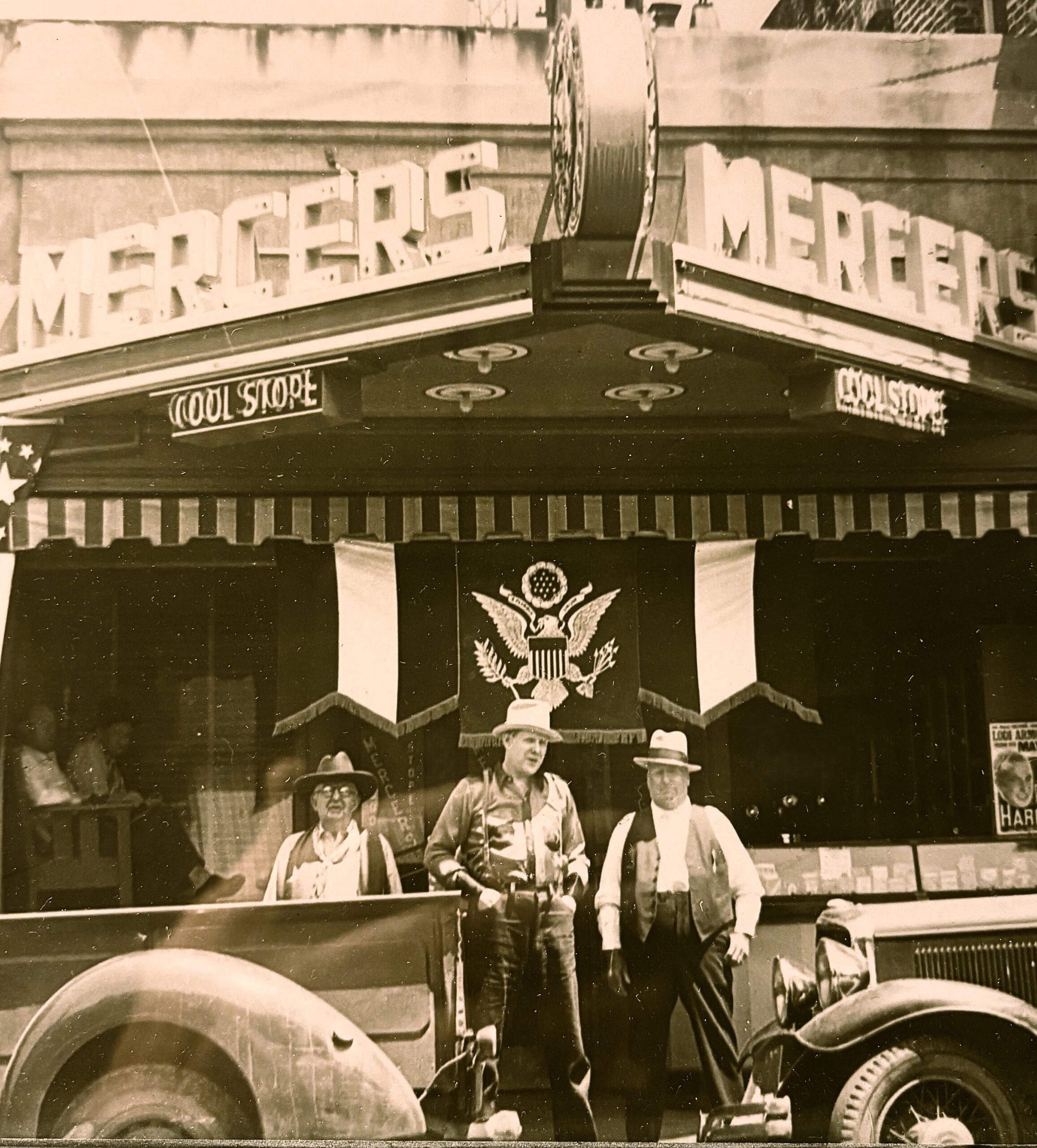
The Mercers bought, improved, and sold businesses for profit, gradually securing their future together. They were owners of the Cal-Nev Club and sold it to go into another venture.
 In 1944 Frank went into partnership with Al Hoffman, purchasing the El Fiesta Night Club. The club was a popular nightlife venue known for its vibrant atmosphere. It featured live music and dancing, attracting locals and visitors alike and was a social hub, often frequented by servicemen during World War II.
La Fiesta Club Ad from 1944.
The couple, as business owners, experienced plenty of excitement running a club in the “Biggest Little City in the World,” which is renowned for its casinos and entertainment.
La Fiesta Night Club in the 1940s
In 1944, shortly after the purchase, Frank saw a policeman fatally shot by a drunken soldier at their club and participated in court proceedings afterward.
In 1945, Dorothy and Frank were taking the day’s revenue to a bank in Carson City when six robbers pursued them. Carol followed Frank’s instructions, outsmarted the thieves, and they escaped safely after a hectic chase. Â Â
In 1946, their circumstances changed unexpectedly due to factors beyond their control. After bartender Tommy Dunn was shot at the La Fiesta Club in Reno, legal troubles emerged for the establishment when Dunn filed a $32,000 lawsuit against owners Frank Mercer and Al Hoffman. During litigation, Hoffman passed away, prompting Mercer to retain new legal representation, which resulted in an additional lawsuit from their former attorney for unpaid fees. The court instructed that the club’s assets be frozen until the disputes involving Dunn and the Nevada Board of Trade were settled. Â Efforts to sell the club were unsuccessful, resulting in its continued closure amid ongoing lawsuits and operational disruptions.
In 1947, facing financial strain during a lawsuit, Frank and Carol Mercer were targeted for eviction by their landlord, Guido Nannini, amid Reno’s housing shortage. According to a newspaper article Nannini claimed Mercer did not make a $1,000 down payment, failed to pay $150 monthly rent since January 31, and owed $1,900 as of March 3 1947. Despite promising to vacate by April 5, the Mercers remained after the property was supposedly sold again. Nannini was seeking possession and $450 in unpaid rent.
In 1949 Dorothy’s father Frank passed away unexpectedly when she was seven years old. He was forty-five at the time, leaving behind his wife, Carol, and their three children: Ella Mae, Dorothy Lou, and Robert.
During this time the Nevada law allowed married women to retain their own property and inherit half of community assets upon their husband’s death. Carol went to court, won her case, and was able to keep all of Frank’s assets. She eventually was able to pay back the loans and debts Frank had incurred.
Carol returned to work, becoming employed at Crystal Bay Club in North Lake Tahoe in Lake Tahoe.
Crystal Bay, Nevada, with the Monte Carlo and Crystal Bay Club casinos, in the 1950s
Carol’s strong work ethic and warm personality led her to become the head cashier. Through years of steady, behind-the-scenes dedication, working at the casino, she was able to provide a stable home and a good life for her three children.
Carol Mercer in the early 1980s, working as head cashier and credit manager at Cal Neva. It is the same casino Frank and Carol had once owned in the 1940s.Â
Her grandchildren were in awe of the amount of money that passed through her hands over the decades of their Grandma Carol overseeing so much money in her career.
Carol passed away at the age of 91 years on March 31, 2005, at her home. She was preceded in death by her husband Frank in 1948, and her son, Bob.Â
Dorothy Mercer: Challenging Gender Norms in Racing
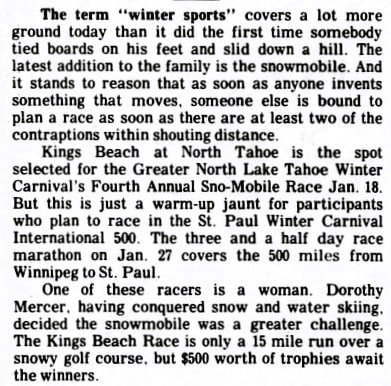
As previously written in Dorothy’s story Part One, Dorothy purchased her first snowmobile in 1965 with winnings from a casino. At the age of twenty-four years, she had found a new “love” in winter sports. Snowmobiles!
Dorothy Mercer racing in the early days.
Dorothy began her competitive racing career in 1968, racing with Norm Sayler, a Polaris Distributor on the west coast. Sayler’s team was known as Donner’s Demons. Dorothy and her sister Ella Mae took part in races ranging from local events to the most prestigious competitions.
Within just two years, Dorothy gained extensive experience, becoming deeply immersed in a sport that would have a lasting impact on her life
Dorothy Mercer emerged as a leading female competitor during the early days of snowmobile racing, a time when men primarily dominated the sport. Her determination and talent demonstrated that women could excel just as much as their male counterparts.
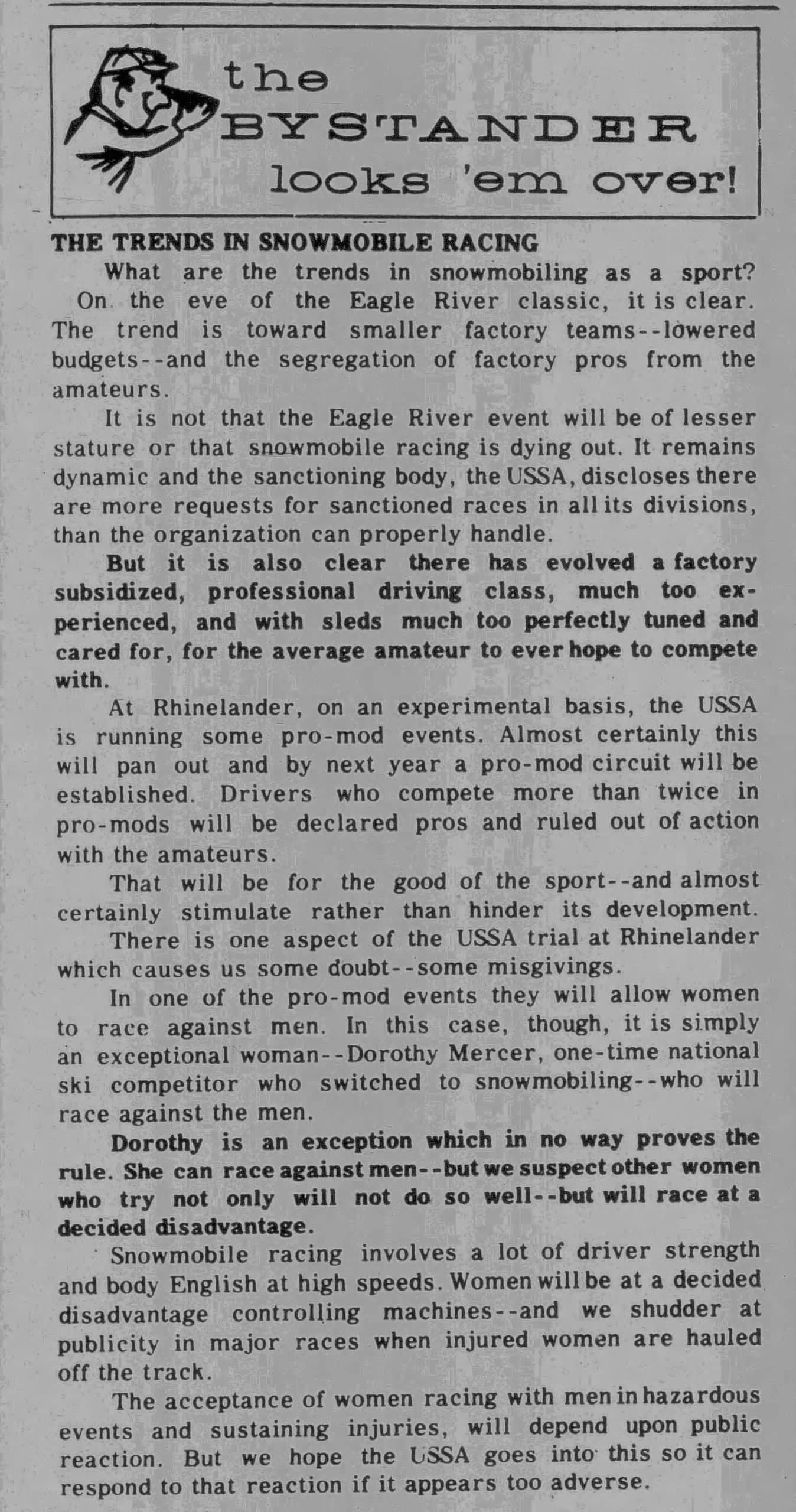
Unlike many of her peers, Dorothy was not content to compete solely in “Powder Puff” events, which were designed exclusively for women. She actively sought out opportunities to race against men, motivated by the excitement and satisfaction of crossing the finish line ahead of them.
Historically, many racing events featured gender-specific categories that restricted women’s participation. Some organizers justified these limitations by citing safety concerns, arguing that women should not compete against men in high-speed races. As a result, certain venues refused to allow female drivers to enter their competitions.
Despite these obstacles, Dorothy Mercer’s achievements helped pave the way for women in today’s professional snowmobile racing.
While many sanctioning associations for oval racing would not allow women to race against the men on the oval, the cross-country groups welcomed the female gender with open arms. Dorothy Mercer thrived in cross-country races, in particular the famed St. Paul Winter Carnival Winnipeg to St. Paul races.
Mercer's Speed Secures a Polaris Ride in 1970!
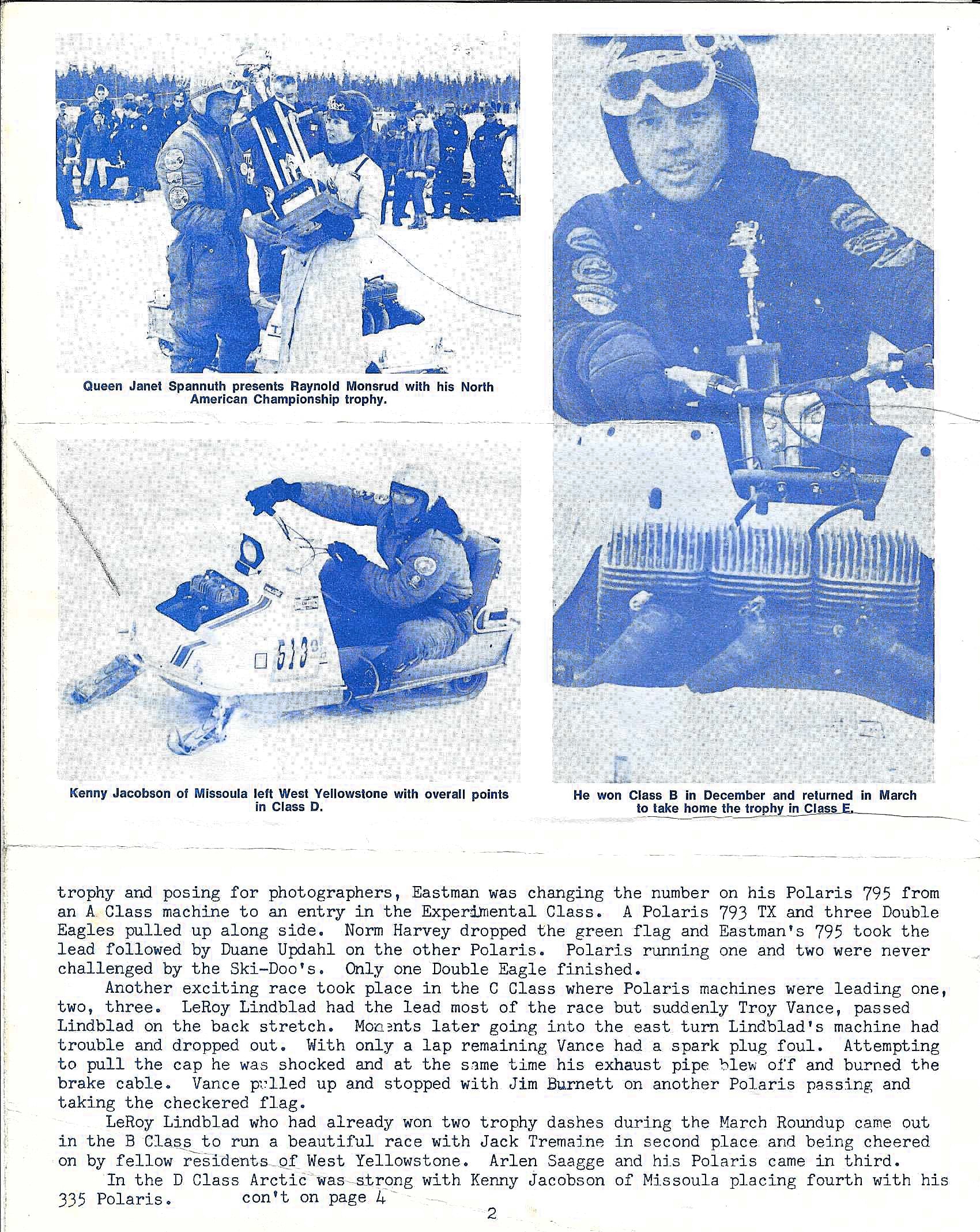
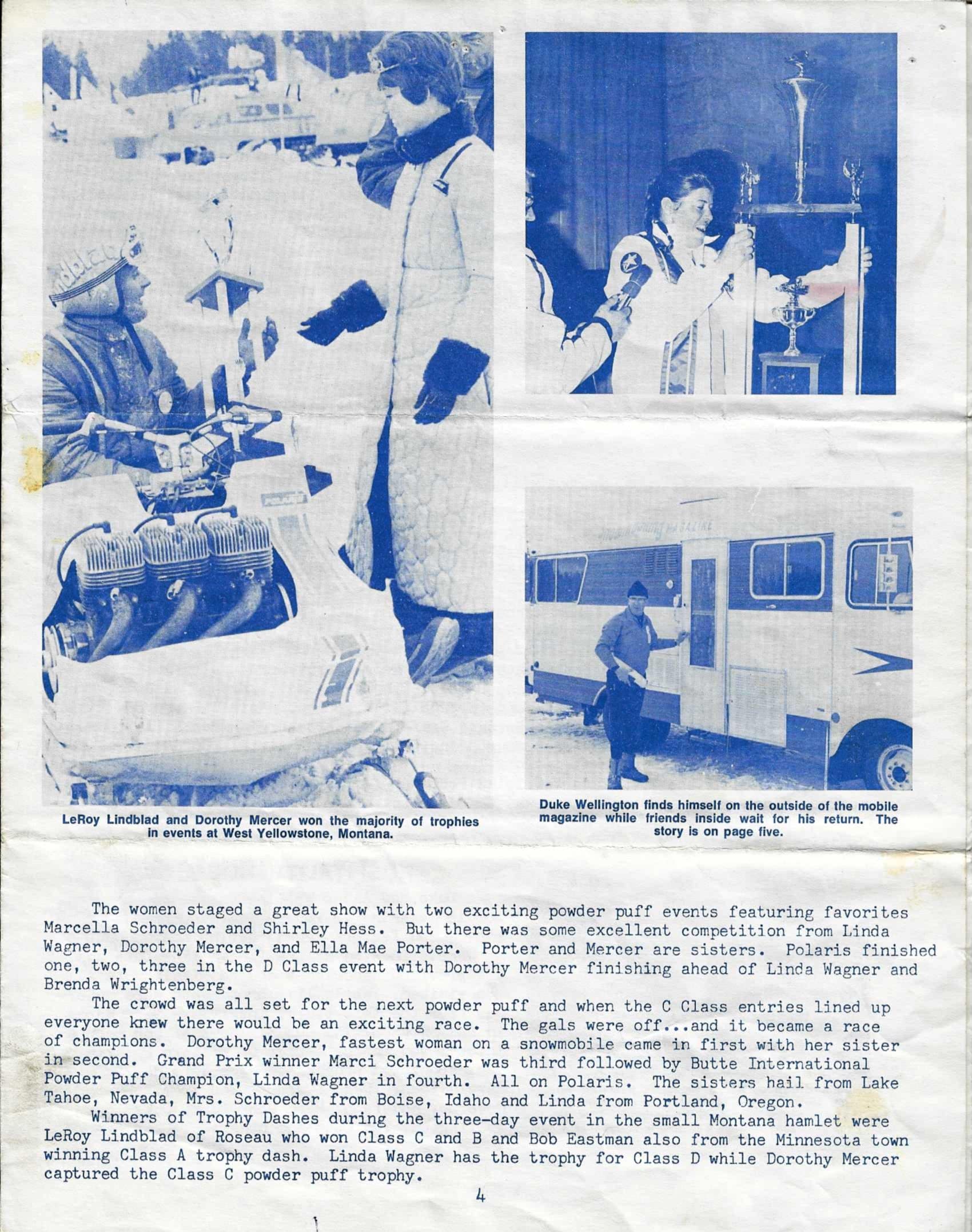
Dorothy and her sister attended the March 1970 West Snowmobile Association North American Championship to participate in powder puff events. They both performed well, winning several classes.
Dorothy Mercer and Ella May Porter in 1970 at West Yellowstone.
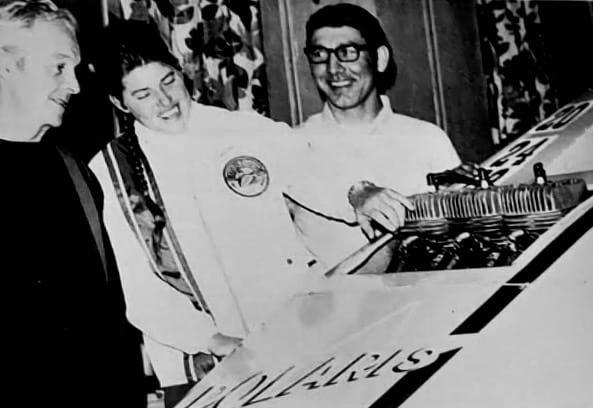
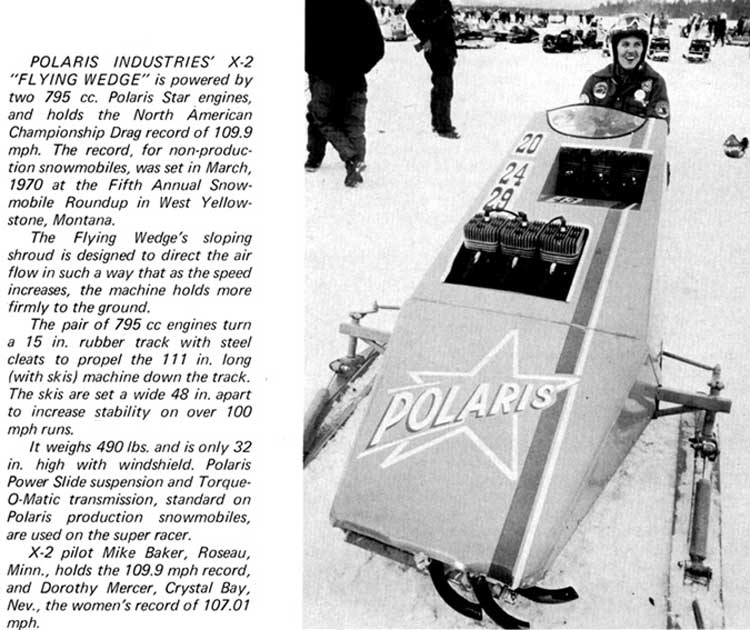
Dorothy had met several Polaris employees in 1969 through Norm Sayler at the Donner Ranch while the Polaris R&D crew were testing. Knowing of her impressive racing record, Polaris department managers of the race team and marketing, Don Erickson and Ted Otto, respectively, asked Dorothy if she’d be interested in running the X-2 for the Women’s class. After much thought, Dorothy convinced herself to do the run.
At the starting line, Dorothy Mercer on the X-2 at Yellowstone in 1970.
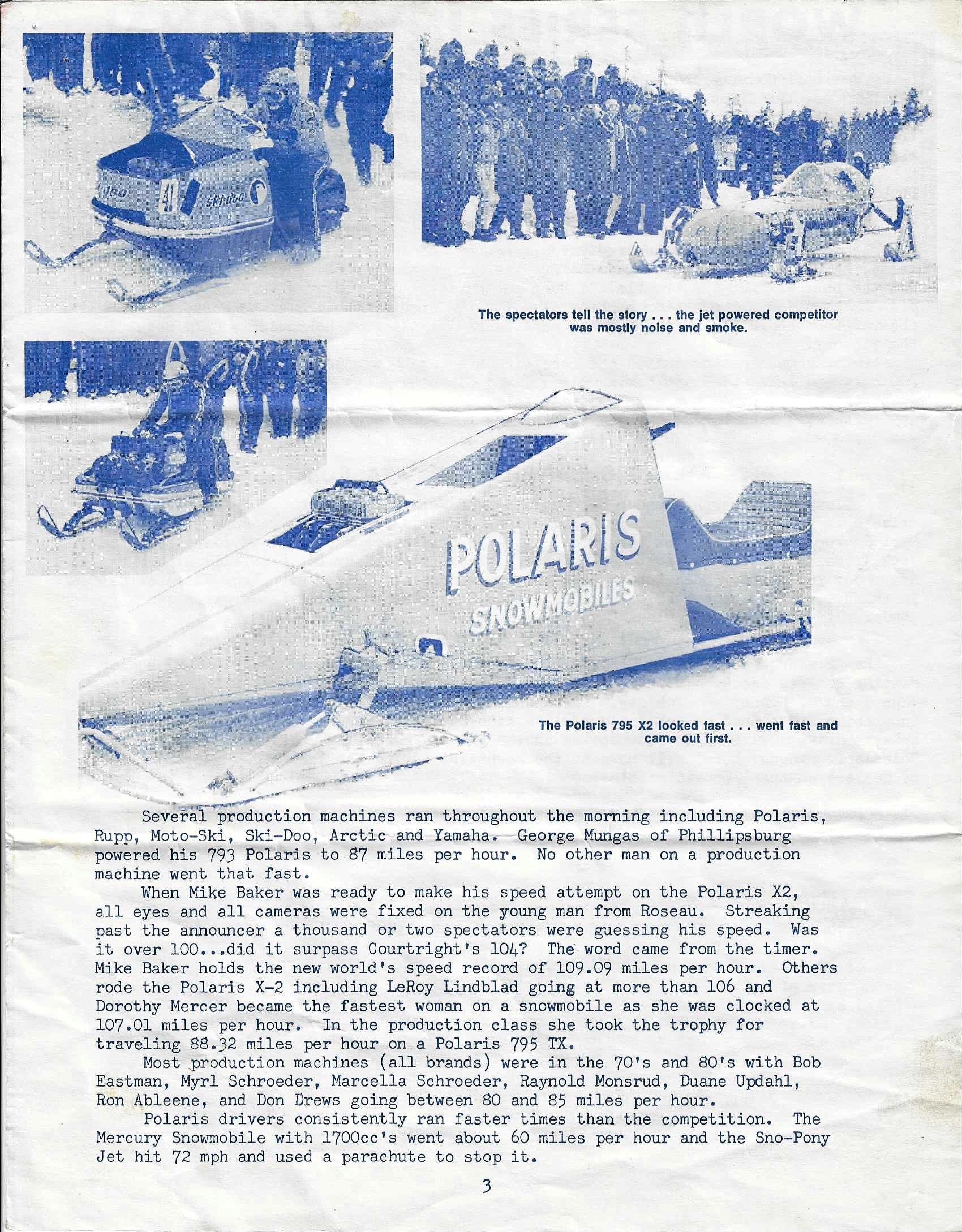
She clocked in at 107.01 miles per hour! Dorothy Mercer became the fastest woman on snow!
History was made, and Polaris soon gained a new employee!
Dorothy Mercer Joins the 1970-1971 Polaris TX Starfire Race Team!
Within less than a year after her performance at the March 1970 W.S.A. World Championship held in West Yellowstone Dorothy became the first woman to be hired driving for a factory race team, working for Polaris Industries.
Dorothy racing the X-2 in West Yellowstone 1970 setting a world record.
During her first year with the factory team, she achieved victory in all four races she entered at Ironwood, Peterborough, and Rhinelander. Additionally, at Eagle River, she secured wins in both of her events. She entered the 1971 St. Paul Winter Carnival Winnipeg to St. Paul I-500-mile race, becoming the first woman to finish, placing sixteenth at the finish line.
The 1971-1972 Polaris TX Starfire Racing Team with Dorothy Mercer!
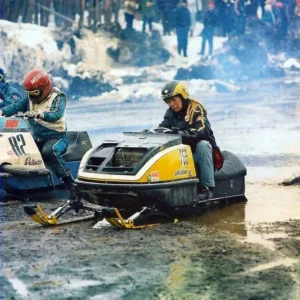
A 1972 Powder Puff event with Dorothy Mercer in the red helmet, on the left.
The second season proved to be successful for Dorothy as a professional driver. Not only was she winning on the race circuit known as the “Queen of the Powderpuff”, but she also proved her ability on the cross-country circuit.
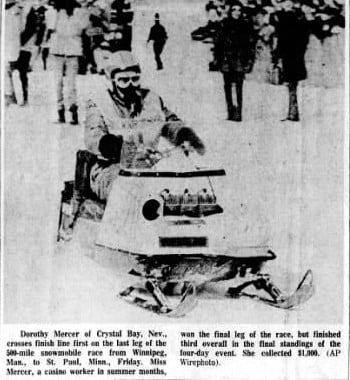
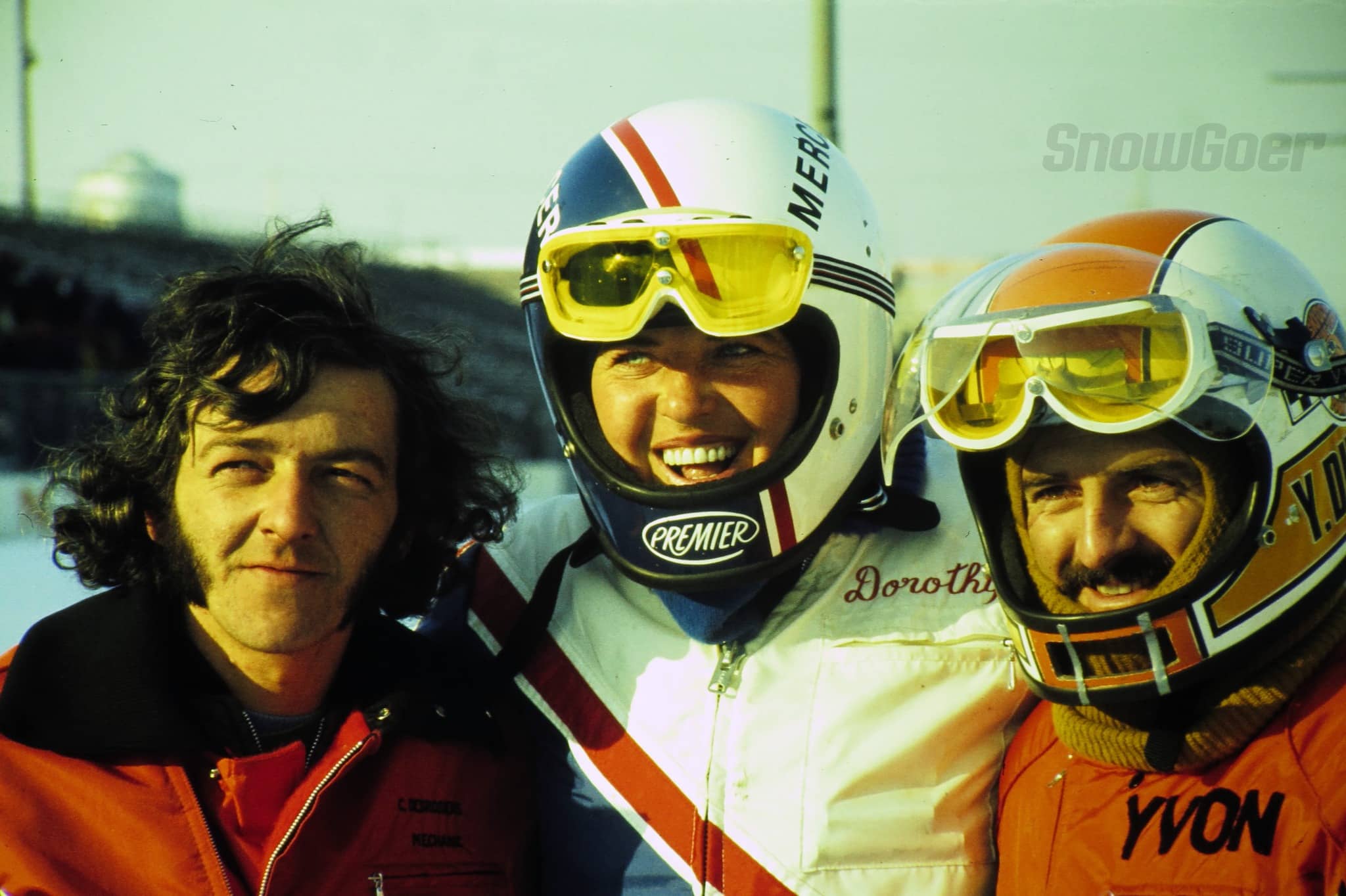
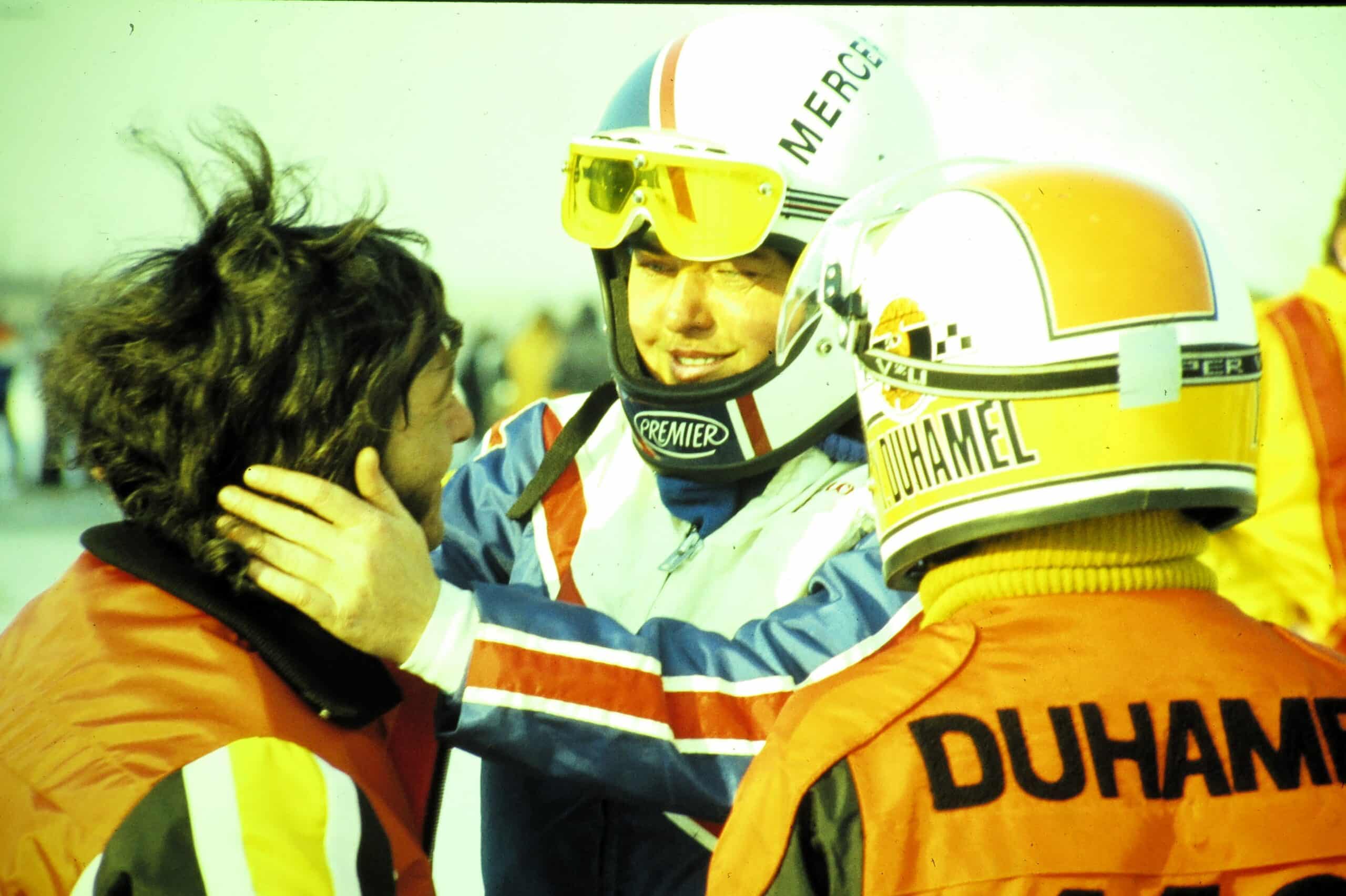
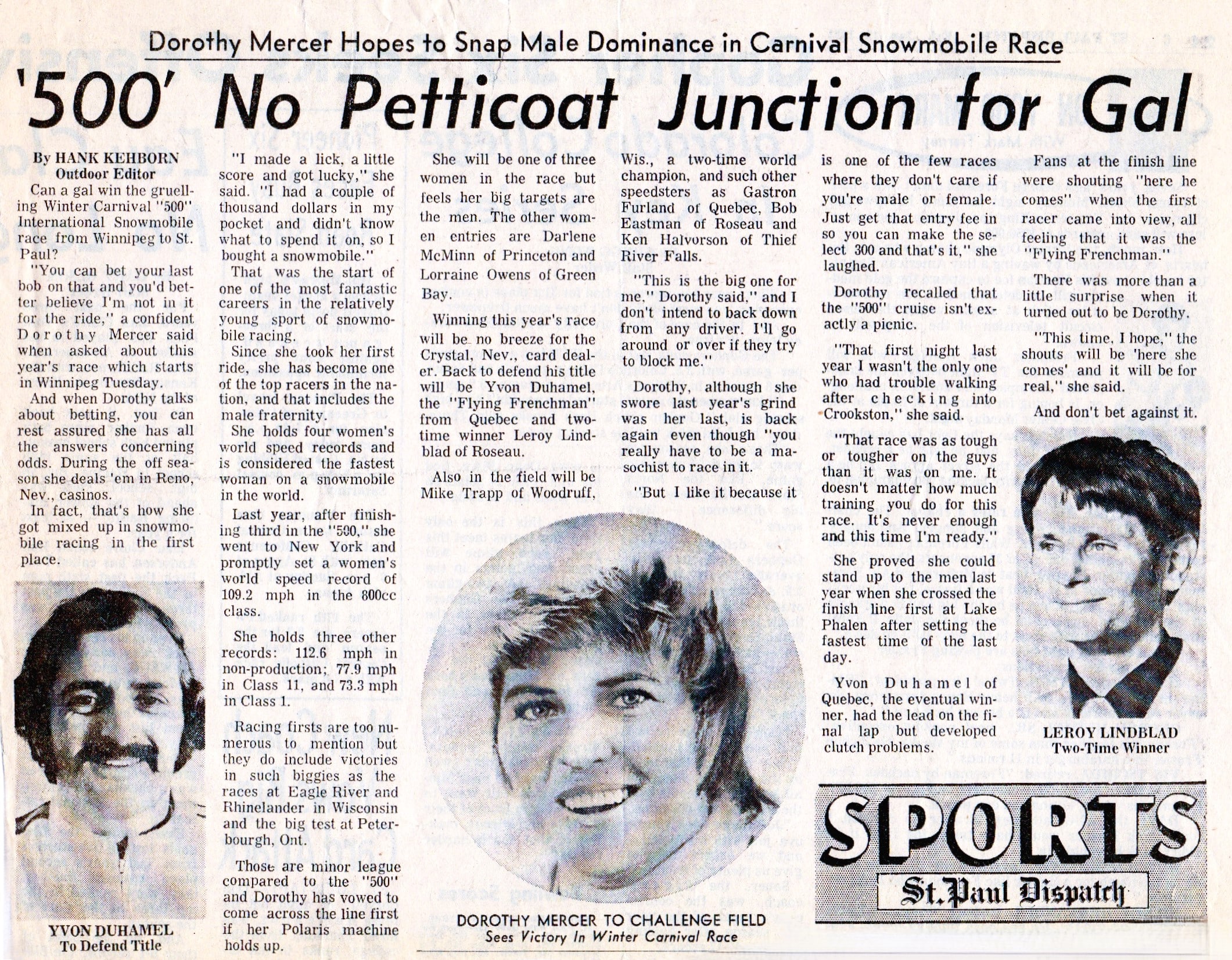
The 1972 St. Paul Winter Carnival Winnipeg-to-St. Paul I-500 is legendary for being one of the most brutal in the event’s history. Dorothy Mercer made history by having fastest time the fourth day of the race. She finishes third overall in a race that “broke” the vast majority of the drivers entered in the race.
Dorothy welcomed at the finish line by the St. Paul Winter Carnival Chairman.
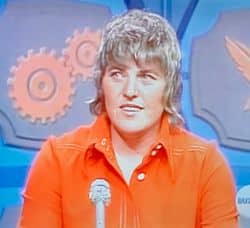
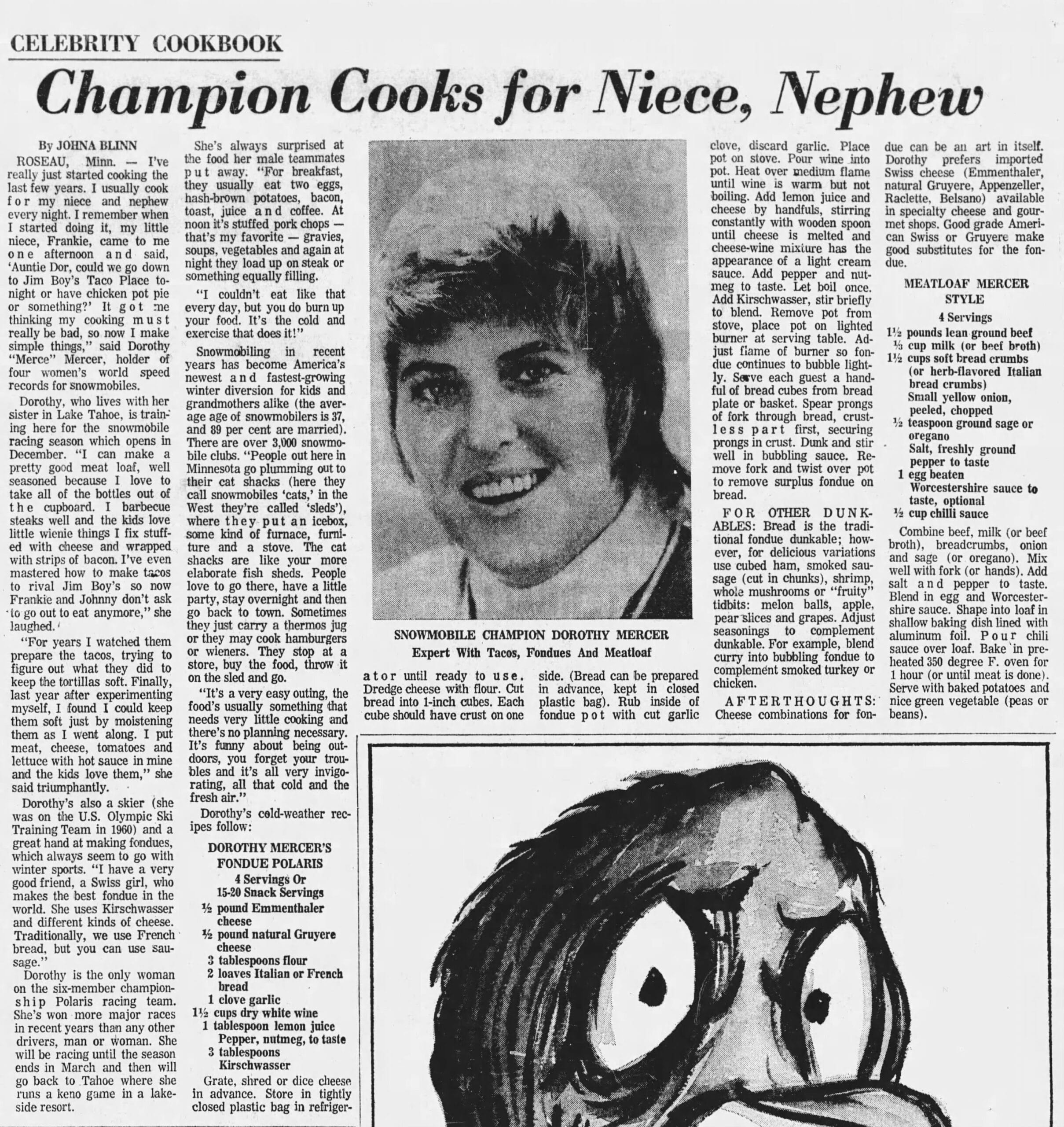
The media was captivated by her achievements, often showcasing her as a trailblazing woman in a sport dominated by men. appearing in numerous publications and on broadcasting programs.
This was especially important for exposure to the public. The corporate heads at Polaris, a Textron Company with headquarters in Plymouth, MNÂ had cut the advertising budgets, thus there wasn’t a lot of coverage or photos in the snowmobile media.
The 1972-1973 Polaris Starfire Kids includes Dorothy Mercer!
In January 1973, Dorothy Mercer broke three world speed records at Boonville. In Class V, she drove an 800cc Polaris to 109.2 MPH. She took the X-2 to 112.6 MPH, 1/10th of a second faster than teammate, Jim Bernat. She broke the records in Class II at 77.9 MPH, and Class I at 73.3. On another occasion she took the Polaris Dragster, the X-3, to a women’s world speed record of 138.7 MPH. She placed fifth in the 1973 St. Paul Winter Carnival I-500.
1973- Polaris team members Don Omdahl, Dorothy Mercer, Wes Pesek.
Dorothy Mercer: Denied, Not Defeated!
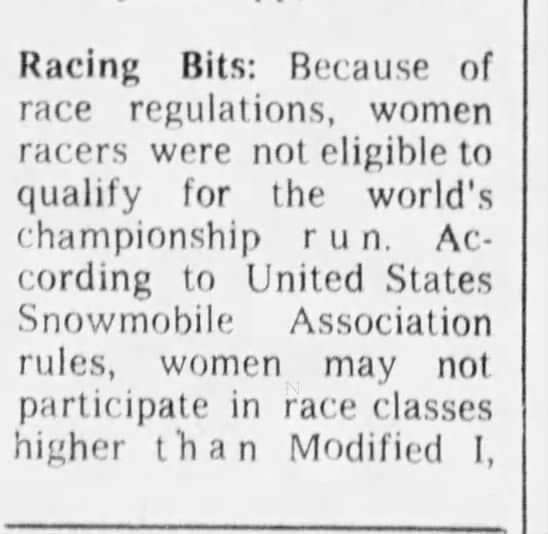
The race machines were getting faster, the competition geared up, great attendance at the events throughout North America. Yet, women still did not have the opportunity so many desired, including the leader of the pack, Dorothy Mercer. The officials were setting rules for sanctioned races not in favor of women running in race classes higher than a Mod I sled.
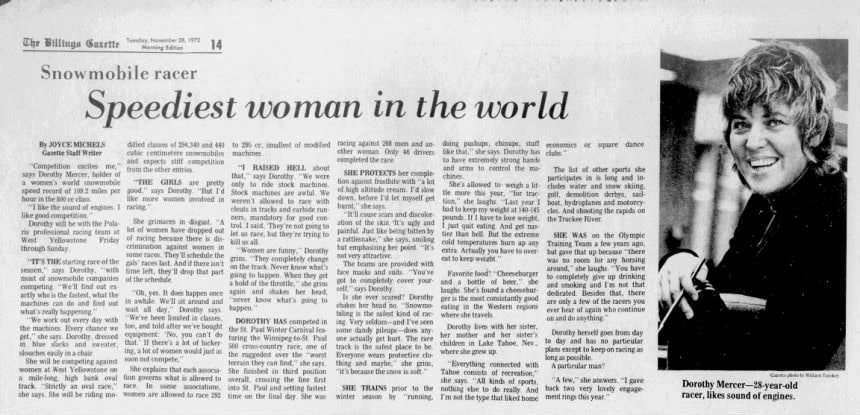
Tuesday, November 28, 1972
Billings Gazette Morning Edition:
“Competition excites me,” says Dorothy Mercer, holder of a women’s world snowmobile speed record of 109.2 miles per hour in the 800-cc class. “I like the sound of engines. I like good competition.”
“THE GIRLS are pretty good,” says Dorothy. “But I’d like more women involved in racing.” She grimaces in disgust. “A lot of women have dropped out of racing because there is discrimination against women in some races. They will schedule the gals’ races last. And if there isn’t time left, they’ll drop that part of the schedule.
“Oh, yes. It does happen occasionally. We will sit around and wait all day,” Dorothy says. “We’ve been limited in classes, too, and told after we have bought equipment: ‘No, you can’t do that.’ If there’s a lot of bickering, a lot of women would just as soon not compete,” She explains that each association governs what is allowed to race. In some associations, women are allowed to race 292 to 295 cc, smallest of modified machines.
“I RAISED HELL about that,” says Dorothy. “We were only riding stock machines. Stock machines are awful. We weren’t allowed to race with cleats in tracks and carbide runners, mandatory for good control. I said, ‘They’re not going let us race, but they’re trying to kill us all.
“Women are funny,” Dorothy grins. “They completely change on the track. Never know what’s going to happen. When they get a hold of the throttle,” she grins again and shakes her head, “never know what’s going to happen.
Despite proving herself on the track time and again, Dorothy Mercer was often met with trivial, even patronizing questions.
- How do you protect your complexion against frostbite? She answered, “With a lot of high-altitude cream. I’d slow down, before I’d let myself get burnt. It’ll cause scars and discoloration of the skin. ‘It’s ugly and like being bitten by a rattlesnake,” she said smiling but emphasizing her point. “It’s not very attractive.”
- Are you ever scared? Â “Snowmobiling is the safest kind of racing. Very seldom–and I’ve seen some dandy pileups.
- Does anyone actually get hurt? “The racetrack is the safest place to be. Everyone wears protective clothing and maybe,” she grinned, “it’s because the snow is soft.“
- Do you have to worry about your weight? “I’m allowed to weigh a little more this year, “for traction,” she laughs. “Last year I had to keep my weight at 140-145 pounds. If I need to lose weight, I just quit eating. And get nastier than hell. But the extreme cold temperatures burn up any extra. Actually, you have to overeat to keep weight.”
- Favorite food? “Cheeseburger and a bottle of beer!” she laughs.
- Any women’s lib satisfaction in beating the men drivers? Â Dorothy replied, “A race is a race. Besides, you can’t tell the sexes under all this garb (snowmobile suits and helmets). And I’m just another racer as far as the men are concerned.”
Dorothy Mercer Leaves Polaris Industries After the 1973 Race Season!
Dorothy Mercer left professional snowmobile racing after the 1973 race season, marking an end of her competitive career after several years as a professional factory driver for Polaris.
She returned to her home in Lake Tahoe, Nevada, living with her sister Ella Mae Porter, her mother Carol, and her sister’s children Frankie and Johnnie. She stated, “Everything connected with Tahoe consists of recreation. There’s all kinds of sports, nothing else to do really. And I’m not the type that liked home economics or square dance clubs.” Â
In her later years, she moved to Carson City she worked in a variety of roles suited to her hands-on nature, including as a bartender at local Tahoe establishments and as a heavy equipment operator, as well as snowplow driving, for the Washoe County Road Department.
She also served as a groundskeeper at a championship golf course in Incline Village and engaged in outdoor activities consistent with her independent lifestyle in the region.
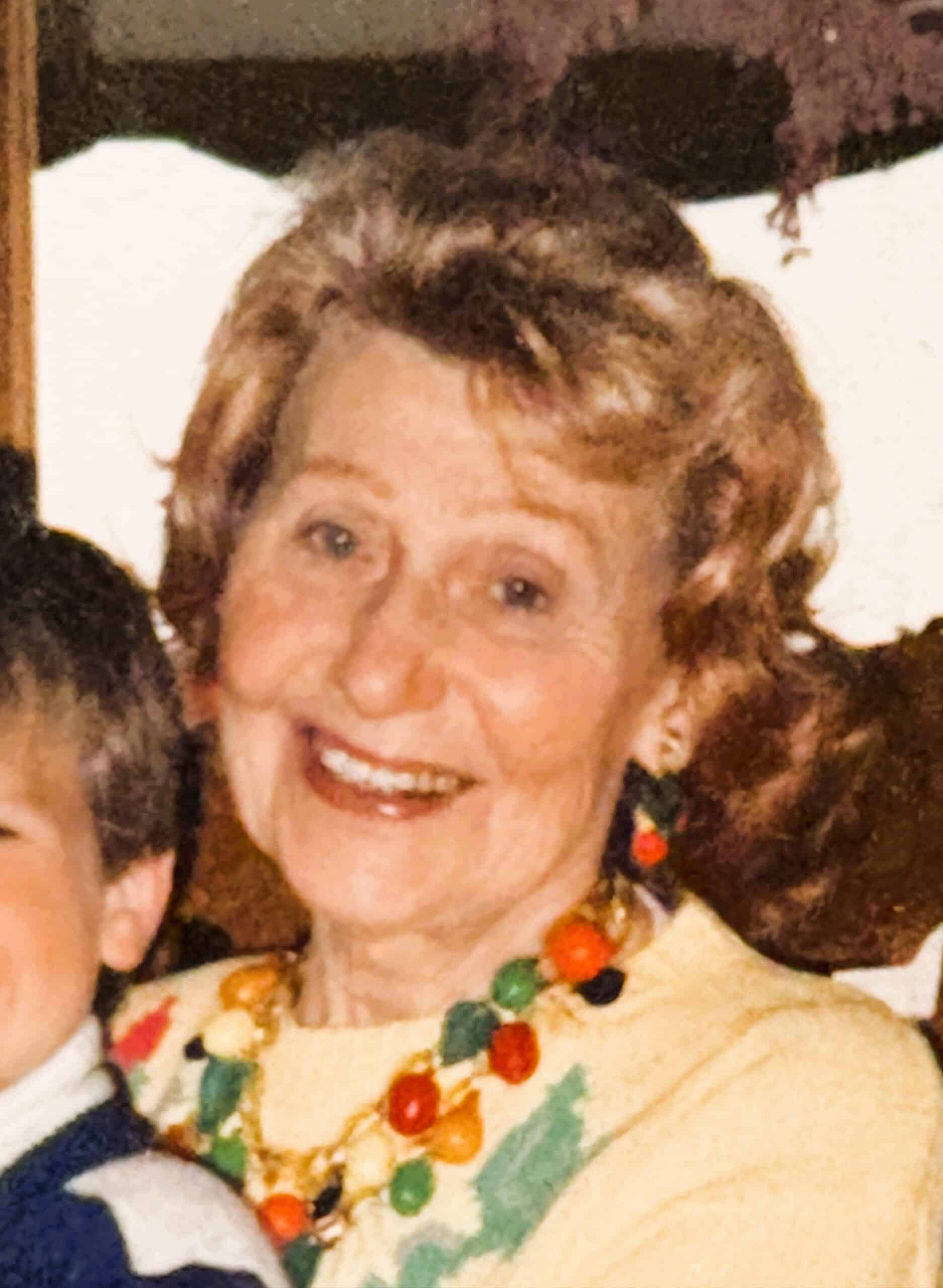
Dorothy and her mother Carol shared memorable moments, exploring and experiencing different areas and modes of transportation. Their love for one another was obvious. The photo above is a good example of their adventurous spirit and close bond.
Dorothy Mercer: Hall of Fame and Best Female Racer Recognition!
She was recognized for her achievements in snowmobile racing when she was inducted into the 1993 Snowmobile Hall of Fame in St. Germaine, Wisconsin, cementing her legacy as one of the most accomplished and influential female racers in the sport’s early professional era. She was acknowledged as The Best Female Racer in the 25th Anniversary edition of Snow Week.
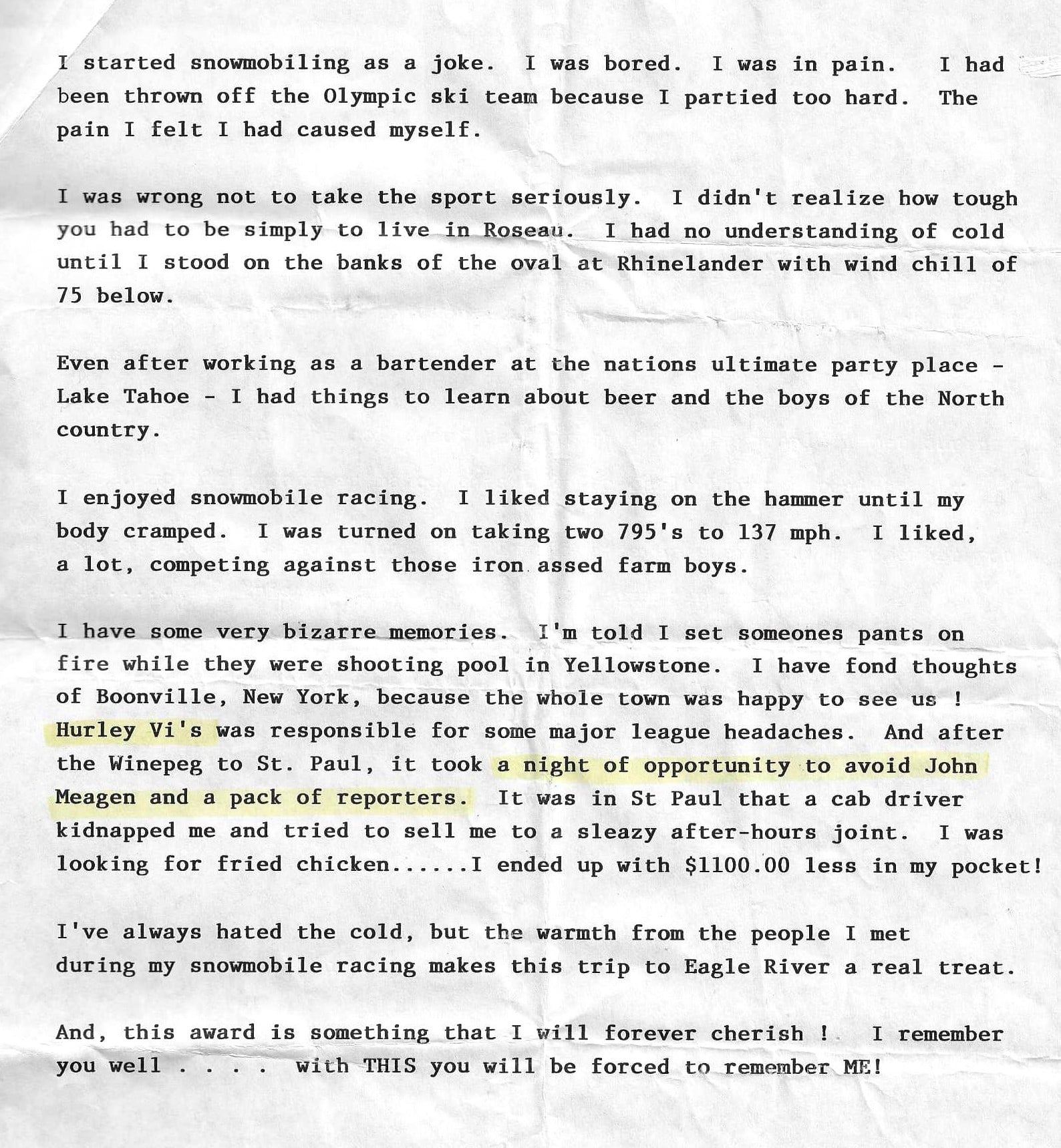
Shown below found in Dorothy’s personal belongings are the original speech notes she gave at the induction ceremony at the Hall of Fame in 1993.
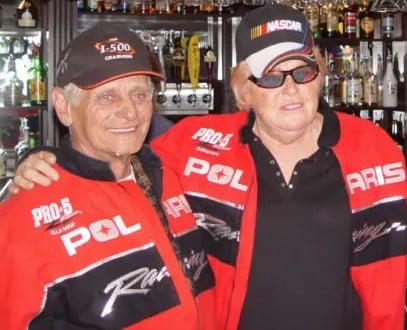
Teammates Once, Friends Forever: Lindblad and Mercer!
Dorothy Mercer: Her Race Is Done, Her Legacy Lives On!
Dorothy Mercer passed away on March 9, 2007, in Carson City, Nevada, from complications of diabetes.
Dorothy’s obituary
An excerpt from Dorothy's Eulogy given by C.J. Hadley:
"Dorothy Mercer was talented. Relentless. Amazing. She was without fear! "... She had big blue eyes, and she curled her eyelashes with a peculiar machine. Her white teeth seemed to glow from inside ... Her laugh was loud. She enjoyed life. She was pretty wild and the only person she was scared of was her mother, Carol." ~March 14, 2007~Carolyn (C.J.) Hadley
"Dorothy was always a breath of fresh air. She inspired the weak, cuddled the sick, embraced the strong. At the end of her life she limped a bit, her shoulders ached, she coughed a bit, but her smile was just as cheeky as ever. And right to the end there was always a sparkle in her eyes and something rotten in the back of her mind that could scare the hell out of the boys from Roseau."
C.J. Hadley on March 24, 2007, at the Tahoe Biltmore in Lake Tahoe, Nevada
Dorothy Mercer Earned Respect
"The late great Dorothy Mercer. Everyone who knew her at Polaris couldn't say enough nice things about her. She more than earned their respect!"
Larry Preston, Starfire Kids
Although there is limited modern coverage of Dorothy Mercer’s contributions her impact has not gone unnoticed. Dorothy is still recognized as a significant role model within the sport.
Her achievements are referenced in Snowmobile Racing Hall of Fame records and surface in occasional retrospectives focused on the development of women’s participation in snowmobile racing. These acknowledgments ensure that Dorothy’s legacy remains a part of the ongoing narrative about the evolution of the sport and the significant role women have played in its history over the decades.
To learn more about Polaris and Its history, visit:
The Polaris Experience Center
Suite #2, 205 5th Avenue SW
Roseau, Minnesota
(218 463-4999
Visit Facebook sites:
Polaris-Roseau
Go Roseau
Written and researched by Carmen Przekwas
Digital Creator Sinnamon Krings, Roseau Promotions Director
References and Photos:
Jon Porter; Norm Sayler; Karolyn Eastman; Ray Monsrud; Carolyn Hadley; Ed Monsrud; Mike Hetteen; Dorothy Mercer personal archive collection; Roseau Times Region Archives; Starfire Kids, Midnight Blue Express by Larry Preston; Polaris Pioneers; Polaris Experience Center; Roseau County Historical Society; Warriors of Winter by Bill Vint; Snow Week; Race & Rally; Snow Tech Magazine; The Sacramento Bee; Grand Forks Herald Archives; The Minneapolis Star; The Duluth News Tribune; Star Tribune-Minneapolis, MN; Polaris Inc.